Menu
📰 EUNACR

Bridging Distance
From the 1982 Communiqué to Trump–Xi 2026: Taiwan and the Changing Logic of U.S.–China Strategic Competition
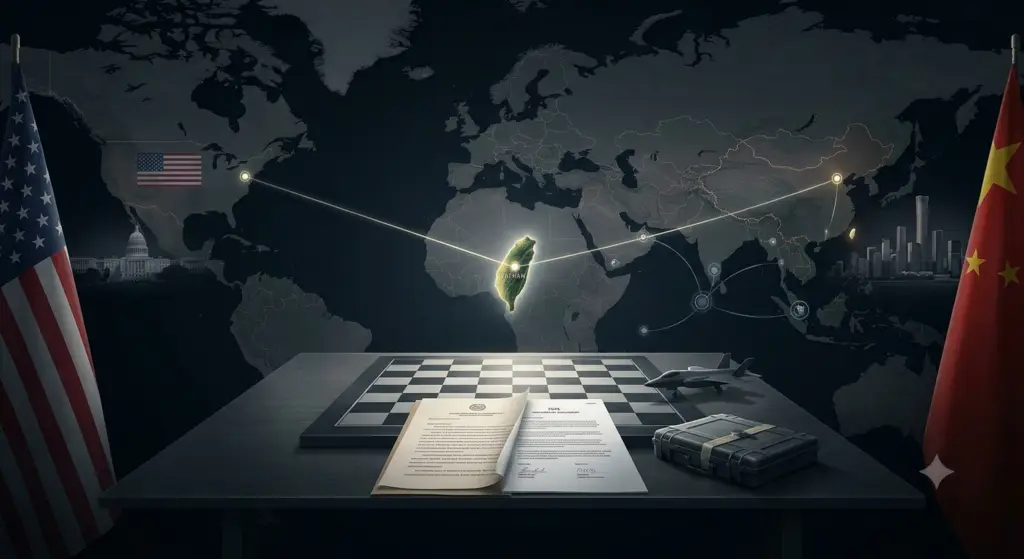
From the 1982 Communiqué to Trump–Xi 2026: Taiwan and the Changing Logic of U.S.–China Strategic Competition:
How Washington’s treatment of Taiwan may signal a shift from constraining Chinese power toward managing it.
EUNACR Analysis | September 2026
Executive Summary:
More than four decades after the United States and the People’s Republic of China concluded the August 17, 1982 Joint Communiqué on U.S. arms sales to Taiwan, the document has once again become relevant to the management of U.S.–China strategic competition. Ahead of the September 2026 Trump–Xi summit in Washington, Beijing is seeking to place U.S. arms sales to Taiwan within the framework of the commitments and understandings established in 1982. Reuters reported that Chinese President Xi Jinping was expected to press President Donald Trump to halt U.S. arms sales to Taiwan, while the Trump administration had delayed a further package estimated at approximately $14 billion. Trump has described the pending package as a “very good negotiating chip” in his broader dealings with Beijing.These developments do not establish that Washington has abandoned Taiwan, accepted Beijing’s sovereignty claim, or formally recognized China as an equal strategic peer. Nor does the 1982 communiqué, by itself, provide a sufficient legal or political basis for such conclusions.The more significant question is therefore different: What does it mean when a policy instrument traditionally associated with Taiwan’s defense is explicitly incorporated into the broader bargaining architecture of U.S.–China relations?
This analysis argues that the answer may point to a broader transformation in Washington’s approach to Chinese power. The emerging pattern is not necessarily a transition from support for Taiwan to accommodation of China. Rather, it may represent a shift from treating the rise of Chinese power primarily as something to be constrained toward managing the consequences of that power through a combination of deterrence, competition, bargaining, and selective accommodation.The distinction is important.China’s growing economic, military, technological and diplomatic weight makes it increasingly difficult for Washington to manage individual disputes in isolation. Trade, technology, critical minerals, regional security, Iran, artificial intelligence and Taiwan are increasingly interconnected within the same strategic relationship.Within this environment, Taiwan may be acquiring an additional strategic function: not merely a security commitment or deterrence problem, but also a variable in the management of the wider U.S.–China relationship.That development could indicate a practical or implicit recognition of China’s great-power weight, but it should not be confused with formal recognition of China as an American “peer superpower.”The distinction between those two propositions is central to understanding the present moment.
1. The 1982 Communiqué Was a Compromise, Not a Settlement
The August 17, 1982 Joint Communiqué emerged from a fundamental contradiction in the newly established U.S.–China relationship. Washington had normalized diplomatic relations with Beijing on January 1, 1979, while simultaneously maintaining unofficial relations with Taiwan. The Taiwan Relations Act, enacted by the U.S. Congress in April 1979, provided the domestic legal framework for continued unofficial relations with Taiwan and for the provision of defensive articles and services. Beijing regarded continuing U.S. arms sales to Taiwan as incompatible with its conception of Chinese sovereignty. Washington, however, did not accept Beijing’s demand for the termination of American arms sales. The negotiations that produced the 1982 communiqué therefore sought something more complicated than a final settlement. They sought a modus vivendi capable of preventing the Taiwan arms issue from destabilizing the wider U.S.–China relationship. The final communiqué contained language under which Washington stated that it did not seek a long-term policy of arms sales to Taiwan, that such sales would not exceed the levels supplied in recent years, and that the United States intended gradually to reduce them over time. But the document did not establish a fixed timetable for terminating arms sales. That distinction is critical. During the negotiations, Beijing had sought a more definitive commitment to ending U.S. arms sales. Washington rejected a fixed termination date. The eventual language was sufficiently flexible for both sides to maintain different interpretations of what the agreement required.
The U.S. historical record explicitly acknowledges this ambiguity. American and Chinese officials emphasized different portions of the communiqué and developed significantly different interpretations of its commitments. Washington emphasized the relationship between reductions in arms sales and Beijing’s commitment to a peaceful approach toward Taiwan; Beijing emphasized the American commitment to reduce arms sales and respect Chinese sovereignty. The ambiguity was therefore not a defect that undermined the agreement. It was one of the conditions that made the agreement possible. The 1982 communiqué should consequently be understood less as a completed settlement of the Taiwan question than as an instrument for managing an unresolved strategic contradiction. That historical characteristic is precisely what makes it relevant again in 2026.
2. The 1982 Framework Was Larger Than the Communiqué
A contemporary analysis that treats the August 17 communiqué as the entire U.S. policy framework toward Taiwan risks producing a misleading picture. The broader architecture also included the Taiwan Relations Act and the Six Assurances communicated by the Reagan administration to Taipei in 1982. The Six Assurances stated, among other things, that Washington had not agreed to establish a date for ending arms sales, had not agreed to consult Beijing before making such sales, had not agreed to mediate between Beijing and Taipei, had not altered its position concerning Taiwan’s sovereignty, had not agreed to revise the Taiwan Relations Act, and would not pressure Taiwan to negotiate with Beijing. The historical record therefore reveals two simultaneous tendencies. On one side was a U.S. commitment to manage and potentially reduce arms sales within the framework established by the 1982 communiqué.On the other was an explicit effort to prevent Beijing from interpreting that commitment as an unconditional American decision to withdraw military or political support from Taiwan. This produced a layered policy structure:
The three U.S.–China communiqués + the Taiwan Relations Act + the Six Assurances + subsequent U.S. interpretations of the framework.
That architecture is important because it demonstrates that American policy toward Taiwan has historically depended upon strategic ambiguity between competing commitments, rather than on a single document or principle.The present debate should therefore not be framed simply as a question of whether Washington is “honoring” or “violating” the 1982 communiqué. The more useful question is how Washington is interpreting and deploying the entire framework under radically different geopolitical conditions.
3. Why Beijing Is Reviving the 1982 Communiqué
For Beijing, the communiqué offers a particularly useful diplomatic instrument because its language provides a historical basis for arguing that Washington once accepted a trajectory toward reducing arms sales to Taiwan. Reuters reported in September 2026 that Xi was expected to invoke the 1982 agreement in pressing Trump to halt U.S. arms sales. China has also continued to describe Taiwan as a core issue in the bilateral relationship and has urged Washington to exercise caution over arms transfers. Beijing’s use of the communiqué serves at least two purposes: First, it places contemporary U.S. arms sales within an established bilateral diplomatic framework rather than presenting them as isolated transactions. Second, it allows China to argue that the current American position represents a departure from an understanding reached during the normalization era. But there is an important limitation to that argument. The United States did not accept Beijing’s interpretation of the communiqué as requiring an unconditional or immediate end to arms sales. The Reagan-era record makes clear that Washington linked reductions to the continuation of a peaceful Chinese approach and explicitly rejected a fixed date for terminating arms sales. Beijing can therefore invoke the communiqué as a diplomatic reference point without that invocation resolving the underlying disagreement over what the document actually requires. This is precisely the type of ambiguity that characterized the agreement in 1982, and it may now be returning as a mechanism of strategic bargaining.
4. Washington’s Position: Continuity Within a More Transactional Framework
The current American position contains an important tension. Washington continues to support Taiwan’s capacity for self-defense and has not formally discarded the established policy framework. At the same time, the Trump administration has demonstrated a willingness to treat at least some Taiwan-related decisions as instruments within broader negotiations with Beijing. This became particularly visible in the handling of the pending approximately $14 billion arms package. Reuters reported that the package had remained delayed following Trump’s May 2026 meeting with Xi and that Trump characterized the prospective sale as a “very good negotiating chip.”
An arms transfer can serve primarily as a defense instrument. Its timing may be determined by assessments of military requirements, deterrence, operational readiness, and regional balance. But once the same instrument is explicitly conceptualized as a negotiating chip, it acquires a second function. Its timing can become part of a broader bargaining calculation.
The question is no longer only:
Does Taiwan require this capability?
It also becomes:
What strategic or economic outcome might Washington obtain from Beijing by approving, delaying, modifying, or withholding it?
That does not necessarily constitute abandonment of Taiwan. It does, however, change the strategic utility assigned to Taiwan-related policy. And that distinction may be more consequential than the fate of any individual arms package.
5. Taiwan Is Becoming Embedded in a Wider Bargaining System
The significance of this development becomes clearer when the Taiwan issue is placed within the wider U.S.–China relationship. The 2026 agenda extends well beyond Taiwan. Trade and tariffs, advanced technology, artificial intelligence, critical minerals, regional security, and Iran are all part of a relationship characterized simultaneously by strategic rivalry and continued negotiation. This matters because the strategic meaning of Taiwan changes when it becomes interconnected with these other issues. If Taiwan is treated primarily as a regional security problem, U.S. decisions concerning the island are principally evaluated through deterrence, military balance, and alliance credibility. If Taiwan-related decisions are incorporated into negotiations involving trade, technology, critical minerals, or other strategic issues, they become part of a wider bargaining system. This does not mean that Taiwan becomes unimportant. The opposite may be true. Its importance may derive increasingly from the fact that decisions concerning Taiwan can affect multiple dimensions of the U.S.–China relationship simultaneously. Taiwan thus becomes both a security issue and a bargaining variable. That is a meaningful strategic change even if the underlying American policy framework remains formally intact.
6. Does This Amount to Recognition of China as a Great Power?
This is the most consequential, and the most easily overstated, part of the argument. There is no basis for claiming that Washington has formally recognized China as an equal American superpower. No such declaration has been made. Nor should the use of the term “great power” be reduced to diplomatic terminology. Great-power status can also be examined through patterns of strategic behavior. A state’s effective weight in an international system is reflected partly in the extent to which other major powers must incorporate its capabilities and interests into their own strategic calculations. In that sense, the current U.S.–China relationship provides evidence of a different kind of recognition: functional recognition of China’s strategic weight.
Washington increasingly has to negotiate with Beijing across multiple domains simultaneously. China cannot be treated simply as a regional military competitor because its economic position, industrial capacity, technological capabilities, critical supply-chain role, and diplomatic reach extend far beyond East Asia. The strategic implication is therefore more subtle than “the United States recognizes China as a peer.”
A more defensible proposition is:
Washington’s behavior may increasingly reflect a practical recognition that Chinese power has reached a scale at which competition must be combined with sustained bargaining and selective accommodation. That is an analytical inference, not a formal statement of U.S. policy. The distinction should remain explicit.
7. From Containment to Managed Competition?
The broader question is whether the United States is moving from a strategy centered primarily on constraining the expansion of Chinese power toward one centered more heavily on managing the consequences of that power. The word “containment” should itself be used carefully. The contemporary China challenge differs structurally from the Soviet challenge of the Cold War. China is deeply integrated into the global economy, central to major supply chains, technologically significant, militarily powerful, and economically connected to U.S. allies and partners. An attempt to prevent Chinese power from expanding across every strategic domain would therefore carry costs for Washington itself. A more sustainable strategic model may instead combine: military deterrence; technological restrictions; alliance strengthening; economic competition; selective cooperation;crisis-management mechanisms; and transactional bargaining. This is not the abandonment of competition. It is competition conducted through a broader management framework. Under such an approach, Washington does not have to choose categorically between confrontation and accommodation. It can compete with China in areas considered strategically sensitive while negotiating with Beijing in areas where mutual interests or escalation risks make bargaining advantageous. The Taiwan question fits naturally into this model precisely because it combines military deterrence, alliance credibility, technological interests, Chinese sovereignty claims, and the risk of escalation.
8. The Strategic Logic of Selective Accommodation
Selective accommodation can serve a rational strategic purpose even in a highly competitive relationship. A major power confronting another major power faces a structural dilemma. Too much accommodation may weaken deterrence and generate uncertainty among partners. Too much confrontation may accelerate military competition, economic fragmentation and geopolitical polarization. The strategic space between those extremes is therefore potentially important. Negotiating over Taiwan-related instruments could give Washington bargaining leverage, create channels for managing broader disputes and allow American policymakers to distinguish between issues requiring deterrence and issues where accommodation may reduce escalation risks. But this logic depends on a critical condition: bargaining must not destroy the credibility of the deterrence it is intended to preserve.
That is where the current approach becomes strategically complicated. If Taiwan-related commitments are treated as negotiable in one context, Beijing may conclude that additional pressure can generate additional concessions. At the same time, U.S. partners could begin to question whether American security commitments remain predictable when they become connected to unrelated economic or geopolitical negotiations. The same instrument that creates leverage may therefore reduce leverage if its use undermines credibility.
9. The Risks of Turning Taiwan into a Bargaining Instrument
The transactional treatment of Taiwan creates at least three strategic risks. The first concerns Taiwan itself. If arms transfers become conditional on developments elsewhere in the U.S.–China relationship, Taiwan’s defense requirements could become partially subordinated to negotiations over issues unrelated to its immediate security environment. The second concerns American alliances. U.S. partners may interpret highly transactional security commitments as evidence that strategic guarantees are contingent rather than durable. This does not necessarily mean that allies will abandon confidence in Washington, but it creates an additional variable in their strategic calculations. The third concerns Chinese behavior. If Beijing concludes that pressure over Taiwan reliably produces concessions in other areas, it may acquire an incentive to intensify that pressure. This creates a potential feedback mechanism:
pressure → bargaining → concession → greater perceived effectiveness of pressure → additional pressure.
The central strategic dilemma can therefore be stated simply:
The more valuable Taiwan becomes as a bargaining instrument, the greater the risk that its bargaining value could weaken its deterrent value.
This is the principal vulnerability of a highly transactional approach.
10. The 1982 Communiqué as a Model of Managed Disagreement
The most interesting historical lesson of the 1982 communiqué may not be its specific language concerning arms sales. It may instead be the mechanism through which the agreement functioned. Washington and Beijing did not resolve their fundamental disagreement over Taiwan. They constructed an arrangement that allowed both governments to continue operating despite that disagreement. The U.S. historical record is unusually clear on this point: American and Chinese officials emphasized different elements of the communiqué and maintained substantially different interpretations. Yet the flexibility of the document enabled both sides to preserve the broader relationship. This suggests that the communiqué can be understood as a model of managed disagreement.
Its purpose was not to eliminate strategic incompatibility. Its purpose was to prevent that incompatibility from destroying the relationship. The relevance to 2026 is therefore conceptual rather than legal. Washington and Beijing may again be searching for mechanisms through which the Taiwan dispute can remain unresolved without allowing it to dominate every other dimension of the bilateral relationship. The contemporary strategic environment is vastly different from 1982. China is considerably more powerful, the regional military balance has changed, Taiwan has developed into a consolidated democracy, and U.S.–China competition now extends into technology, trade, and global economic governance. Nevertheless, the underlying diplomatic problem is familiar:
How can two major powers manage a fundamental disagreement without allowing it to become the organizing principle of their entire relationship?
11. Three Strategic Trajectories
The developments of 2026 do not establish a single inevitable direction. At least three trajectories remain analytically plausible.
Trajectory One: Expanded Strategic Bargaining:
Washington could increasingly incorporate Taiwan-related decisions into negotiations over trade, technology, critical minerals, regional security, and other areas. Under this model, Taiwan policy would become more deeply embedded in the broader architecture of U.S.–China bargaining. The advantage would be greater diplomatic leverage. The risk would be a gradual erosion of the distinction between Taiwan’s immediate security requirements and unrelated bilateral negotiations.
Trajectory Two: Reassertion of Deterrence:
Washington could conclude that excessive bargaining over Taiwan creates unacceptable risks to deterrence and alliance credibility. In that case, arms transfers could once again be framed predominantly through Taiwan’s defense requirements and the regional military balance, with greater separation between security commitments and economic negotiations. The advantage would be clearer signaling. The risk would be reduced flexibility in using Taiwan-related decisions as leverage in broader negotiations.
Trajectory Three: Institutionalized Strategic Ambiguity:
A third possibility is that ambiguity itself becomes the enduring framework. Rather than choosing fully between confrontation and accommodation, Washington and Beijing could preserve unresolved disagreements while establishing practical boundaries designed to prevent escalation. This would have a certain historical resemblance to the logic underlying the 1982 communiqué. Neither side would obtain everything it wants. Neither would necessarily regard the underlying dispute as resolved. But both could calculate that controlled ambiguity is preferable to direct strategic confrontation. These trajectories are not predictions. They are analytical possibilities whose realization would depend on decisions in Washington, Beijing and Taipei and on developments in the wider Indo-Pacific strategic environment.
EUNACR Analytical Assessment:
The significance of the Trump–Xi encounter should therefore not be measured solely by whether Washington approves, delays or modifies a particular Taiwan arms package. The more consequential issue is what strategic function the package is being assigned. The 1982 communiqué established an American intention to reduce arms sales to Taiwan over time, but it did so within a deliberately ambiguous framework. The Taiwan Relations Act and the Six Assurances simultaneously constrained Beijing’s interpretation of that commitment and preserved Washington’s ability to support Taiwan’s self-defense. The strategic environment of 2026 is fundamentally different. China is no longer the comparatively weaker power Washington managed during the early period of normalization. It is a major economic, industrial, technological, military, and diplomatic actor whose interests affect American calculations across multiple regions and policy domains. At the same time, Washington has not formally abandoned Taiwan, nor has it publicly accepted Beijing’s sovereignty claim over the island. The more significant development lies between these two positions. The Trump administration’s characterization of a pending Taiwan arms package as a negotiating instrument provides evidence of a more transactional approach to at least one component of Taiwan policy.
EUNACR therefore assesses that the emerging pattern may reflect a broader transition:
from a strategy primarily concerned with constraining the expansion of Chinese power toward one increasingly concerned with managing the consequences of Chinese power.
This should not be interpreted as the disappearance of strategic competition. Rather, it suggests that Washington may increasingly regard China as a sufficiently consequential great power that competition must coexist with structured bargaining, selective accommodation and mechanisms for controlling escalation. That is a materially different strategic logic from one based principally on preventing the expansion of Chinese influence. The central question is consequently shifting. It is no longer simply:
How can the United States constrain the expansion of Chinese power?
It is increasingly:
How can the United States compete with China while managing the reality of Chinese power and preventing competition from escalating into systemic confrontation?
Taiwan sits at the center of that dilemma because it simultaneously represents a security commitment, a deterrence problem, a sovereignty dispute, an economic and technological actor, and a potential bargaining instrument. That combination makes Taiwan more, not less, strategically significant.
Conclusion
The return of the August 17, 1982 communiqué to the center of U.S.–China diplomacy demonstrates the durability of the Taiwan question, but it also reveals something about the changing structure of the relationship itself. In 1982, Washington and Beijing were attempting to prevent disagreement over Taiwan from destroying a newly normalized strategic relationship. In 2026, the problem is different. The United States and China are managing a relationship between two major powers whose competition extends across trade, technology, military security, critical resources, regional influence, and global geopolitics. The United States has not formally declared China an equal strategic peer, and Washington has not formally abandoned its established commitments toward Taiwan. Nevertheless, the increasing willingness to incorporate Taiwan-related instruments into broader negotiations may reasonably be interpreted as evidence of a practical or implicit recognition of China’s great-power weight.
The significance of this development lies less in any single arms package than in the strategic logic behind its treatment. If Taiwan-related decisions become increasingly connected to bargaining over the wider U.S.–China relationship, Taiwan will occupy a different position within American grand strategy: not merely as an object of deterrence and defense policy, but as one of the variables through which Washington and Beijing manage their broader competition. That does not mean that the Taiwan question is being resolved. It may mean almost the opposite. The emerging model could be one in which Washington and Beijing accept that fundamental disagreement over Taiwan will persist, while attempting to prevent that disagreement from becoming the organizing principle of their entire relationship. In that sense, the enduring significance of the 1982 communiqué may not be that it offers a ready-made solution for 2026. Its significance may be that it demonstrates how major powers can construct ambiguity around an unresolved strategic dispute and use that ambiguity to preserve a wider relationship. The central transformation, therefore, may not be a formal change in U.S. policy toward Taiwan. It may be a change in the strategic context in which that policy is being applied. Taiwan is increasingly situated at the intersection of deterrence, bargaining and great-power management. And that makes the question of Taiwan larger than Taiwan itself. It is becoming a test of how the United States and China will manage the boundaries of their emerging strategic competition, and, ultimately, of whether great-power rivalry can be managed without becoming systemic confrontation.